
Sciatica Physiotherapy Treatment in Shalimar Bagh: Understanding Your Back Pain
Most patients who visit our physiotherapy centre in Shalimar Bagh with back pain ask one specific, worried question: “I hope I’m not suffering from sciatica?”
If you are feeling a sharp, radiating pain that travels from your hip down to your foot, you aren’t alone. Let’s dive deep into what sciatica actually is, what causes it, and—most importantly—how you can find relief.
What Exactly is Sciatica?
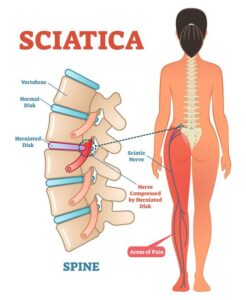
Sciatica isn’t a disease itself; it’s a set of symptoms. It refers to pain, tingling, or numbness that follows the path of the sciatic nerve.
Where does it hurt?
The sciatic nerve is the longest nerve in your body. When it is compressed or irritated, you may feel:
Sharp, aching pain in the lower back or buttock.
A “burning” sensation down the posterior thigh and calf.
Numbness or weakness that travels all the way to your foot.
How Common is It?
According to StatPearls/NIH (2025), the lifetime incidence of sciatica is estimated to be between 13% and 40% globally. While it can feel debilitating, the majority of cases respond exceptionally well to targeted physiotherapy.
Common Causes of Sciatic Nerve Pain
Understanding the “why” is the first step toward recovery. In our clinical experience, sciatica usually stems from three main areas:
1. Sedentary Lifestyle & Sudden Strain
Modern life often involves prolonged sitting, which weakens the core and stiffens the spine. Sciatica often strikes when someone with a sedentary routine suddenly attempts to:
Lift a heavy object incorrectly.
Play a high-impact sport without a proper warm-up.
Start a vigorous exercise schedule too quickly.
2. Disc Prolapse (Herniated Disc)
This is the most frequent medical cause. When an intervertebral disc between your spinal bones is “pressed” or prolapsed, it can leak or bulge, putting direct pressure on the nerve roots.
3. Pelvic & “Sitting Bone” Dysfunction
Your pelvis is the foundation of your spine. If there is a dysfunction in the sacroiliac joint or the piriformis muscle (near your “sitting bone”), it can “trap” or create traction on the sciatic nerve, mimicking disc pain.
The Physiospot Difference: A Holistic Path to Recovery
If your pain is preventing you from walking, sleeping, or working, it’s time for a professional assessment.
At our Shalimar Bagh clinic, we believe that treating sciatica requires more than just a “quick fix.” While traditional modalities like heat therapy or electrical stimulation have their place in pain management, we go a step further to ensure the pain doesn’t return.
1. Restoring Pelvic Alignment
Your pelvis is the foundation of your spine. If your “sitting bones” or sacroiliac joints are out of alignment, they can create unnecessary traction on the sciatic nerve. We use specialized joint mobilizations to restore natural movement and take the pressure off the nerve.
2. Core Strengthening & Stability
A weak core is often the silent culprit behind disc prolapse. We design personalized exercise programs to “brace” your spine from the inside out. By strengthening the deep stabilizer muscles, we reduce the load on your intervertebral discs.
3. Beyond Traditional Modalities
We move beyond basic physiotherapy. By combining manual therapy with biomechanical correction, we offer a holistic treatment plan designed to get you back to walking, sleeping, and working without the shadow of sciatic pain.
Don’t let the pain linger. Early intervention is the key to preventing long-term nerve irritation.