
Zoom meeting invite? Check.
Emails sent? Check.
Healthy sitting posture? Uncheck.
We all start the day intending to sit straight. But let’s be honest: how long can you actually maintain that “perfect” posture while working on a laptop? Five minutes? Two?
As a Physiotherapist treating corporate professionals across all industries and hierarchies, I see this story every day. Whether you are an intern or a manager, the complaints remain the same:
“My shoulder is stiff.”
“My lower back hurts.”
In severe cases, this mechanical stress involves the nerves, manifesting as chronic headaches, arm tingling, or radiating leg pain (sciatica).
Here is the hard truth: These pains aren’t just annoying; they are stealing your work efficiency and degrading your quality of life.
The Problem with “Quick Fixes”
Most people try to manage this damage with the usual suspects:
Applying strong pain balms.
Taking painkillers when it gets unbearable.
Or simply ignoring it (India’s classic ‘Chalta Hai’ attitude).
These might numb the pain sensation temporarily, but never fix the root cause. To stop the pain for good, we need to look deeper than your sore shoulders. We need to look at your biomechanics/ body’s structural alignment.
The Scale of the Problem: You Are Not Alone
If you feel like your body is breaking down, the data backs you up. Research from the National Center for Biotechnology Information (NCBI) highlights just how widespread these “office injuries” are among computer users:
25.3% suffer from chronic Backache.
22.3% struggle with persistent Neck Pain.
20.7% report frequent Headaches.
These aren’t just statistics; they are warning signs that your desk setup is actively hurting you. To stop this pain for good, we need to look deeper than your sore shoulders. We need to look at your biomechanics.
The Mechanics of the “Slump”: Forward Head Posture
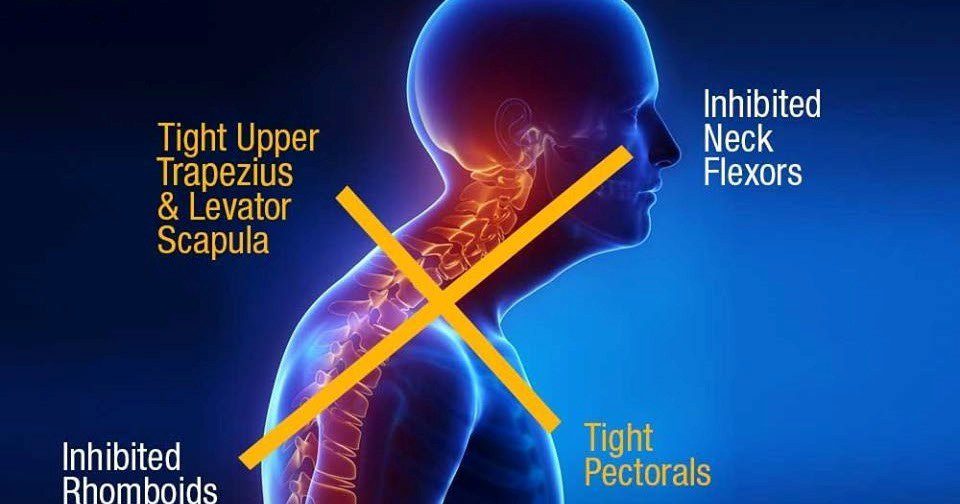
Look at the image above. You might have come across the term Forward Head Posture (FHP).
In this position, your head pokes forward, and the junction between your neck and upper back develops a noticeable curve—often forming a “hump-like” posture.
This isn’t just about looking slouchy. It creates a muscle imbalance:
The Front: Deep neck muscles become weak and inactive.
The Back: Upper Trapezius and neck muscles become tight and shortened from working overtime to hold your head up.
The Result: A constant “tug-of-war” that your muscles are losing.
The Chain Reaction: How Your Body Compensates
The human body has one primary goal: Keep your eyes level and your head balanced over your tailbone (sacrum).
When you slouch, you disrupt this balance. To keep you from falling over, your body triggers a cascade of compensation.
Your Upper Back (Thoracic Spine) rounds forward to support the heavy head.
Your Pelvis/Tailbone tilts backward (Posterior Pelvic Tilt) to counterbalance the upper back.
This is the classic “Corporate Slump” I see in daily practice. However, every body is unique. Depending on your history, your compensation pattern might differ—which is exactly why generic advice often fails.
Why “Good Posture” is More Than Just Looking Confident
Why does this alignment actually matter? It comes down to joint longevity.
When you sit improperly for 8+ hours a day:
Shortened muscles restrict your joint movement, making you feel “stiff” and “locked up.”
Lengthened (overstretched) muscles fail to support the joint, leaving it unstable.
This combination drastically increases the load on your joint surfaces, leading to early joint degeneration and chronic inflammation. You aren’t just “sore”—you are aging your spine faster than necessary.
The Physiotherapy Advantage: Fixing the Root Cause
If we fix these muscle imbalances by treating the root cause, we can save you from the long-term pain of joint degeneration. But you cannot fix a complex structural problem with a simple “stand up straight” command.
This is where a Physiotherapist is essential.
We don’t just guess; we identify the specific compensatory patterns unique to your body.
Mobilization: We use hands-on manual therapy to mobilize stiff joints and correct misalignment.
Stabilization: We prescribe specific strengthening exercises to “wake up” the weak muscles and stretching routines to release the tight ones.
Knowledge is the first step towards recovery. Don’t let gravity win.
Stop Guessing. Start Healing.
You now understand the “Structural Secret.” You know that your pain isn’t just about a stiff neck—it is a chain reaction starting from your biomechanics.
But knowing the why is only the first step. The solution requires a roadmap built for your unique body.
Generic YouTube stretches cannot see your specific compensations. They cannot tell if your pelvis is tilted or if your deep neck flexors are weak. Trying to fix a complex structural issue with generic advice often leads to more frustration—or worse, more pain.
Don’t let your desk dictate your health.
At Physiospot, Shalimar Bagh, Dr Komal Kurseja (PT) specializes in identifying the root cause of corporate pain. In your comprehensive Structural Assessment, we will:
Pinpoint your exact compensatory patterns.
Mobilize the joints that are stuck.
Build a custom plan to restore your energy, focus, and posture.
Your body is your most valuable career asset. It’s time to invest in it.
Such a well written article. Highlights the importance of good posture and also suggests measures to tackle the problem.
Thank you so much Doctor for your valuable insights.
This feels like it is written for me. Have been neglecting my posture. Booking an appointment right away.
Thank you ma’am.
For booking an appointment you can contact us on: 8700131042. Our visit our physiotherapy clinic conveniently located in Shalimar Bagh. Address- BR- 46-A, Shalimar Bagh